
Cruise Embarkation Day Guide: How to Start Your Cruise Without the Stress
A practical step-by-step guide to arriving at the port, checking in, managing your luggage, and making the most of your first few hours onboard.
What Is Cruise Embarkation Day?
Embarkation day is the day you check in at the cruise terminal and board the ship. It includes luggage drop-off, security screening, document checks, cruise-line check-in, boarding, the required safety drill, and getting settled onboard.
It is also one of the most logistics-heavy days of a cruise. The experience is much easier when you treat it as a travel day with firm deadlines rather than as a hotel check-in where arriving a little late usually does not matter.
I have seen this risk become real for a client who planned to fly in on embarkation day. An airline connection problem caused the client to miss boarding and lose thousands of dollars after declining travel insurance. That experience reinforced the advice I already give: whenever reasonably possible, do not depend on a same-day flight to reach your cruise.
A Simple Embarkation Day Timeline
| When | What to Do | Why It Matters |
|---|---|---|
| Several days before | Complete online check-in, confirm documents, download the cruise-line app, and attach luggage tags. | Fixing an issue at home is much easier than fixing it at the terminal. |
| One day before | Travel to the departure city, check into a hotel, and confirm transportation to the port. | This creates a buffer for flight delays, cancellations, traffic, and weather. |
| Morning of the cruise | Eat breakfast, check the cruise-line app, verify the terminal, and keep documents with you. | Some ports have multiple terminals, and assignments can vary by ship. |
| Assigned arrival window | Go to the terminal, hand checked bags to an authorized porter, and proceed through security and check-in. | Arriving near your assigned time helps avoid unnecessary waiting and congestion. |
| After boarding | Complete the safety requirements, confirm reservations, eat lunch, and wait for the cabin announcement. | Cabins and checked luggage may not be available immediately. |
Step 1: Arrive in the Port City the Day Before
For anyone flying to the departure port, arriving the day before is one of the most important choices you can make. Cruise ships operate on firm schedules. If your flight is delayed, the ship generally will not wait for you simply because the airline caused the problem.
When comparing pre-cruise hotels, look beyond the room rate. Consider:
- distance from the correct cruise terminal
- airport and port shuttle availability
- shuttle costs and reservation requirements
- late-arrival policies
- nearby restaurants or breakfast options
- parking packages if you are driving
Do not assume that a hotel advertising a “cruise shuttle” provides free transportation or serves every terminal. Confirm the current details before booking.
See our Pre & Post Cruise Hotels Guide for help comparing your options.
Step 2: Prepare Your Documents Before Leaving the Hotel
Before heading to the terminal, make sure every traveler has the documents required for that specific itinerary. Requirements can depend on citizenship, age, departure port, destinations, and whether the cruise is closed-loop or ends in another country.
Your embarkation document check should include:
- passport or other permitted citizenship documentation
- government-issued photo identification when required
- cruise boarding pass
- any required visas or travel authorizations
- documents required for children traveling without both parents
- travel insurance and emergency contact information
Check names carefully. The name on the cruise reservation should match the traveler’s documentation. Never pack these documents in luggage you plan to hand to a porter.
For more detail, read our passport requirements guide and verify final requirements with the cruise line and appropriate government authorities.
Step 3: Pack a Carry-On for the First Several Hours
Checked bags may not reach your cabin until later in the afternoon or evening. Your carry-on should contain anything you cannot safely be without during that time.
A practical cruise carry-on may include:
- medications in their original containers
- passports, identification, and boarding documents
- phone, charger, and portable battery
- wallet, valuables, and essential electronics
- swimsuit, sunscreen, and sunglasses
- a change of clothes and basic toiletries
- items needed for children during the wait
Keep the bag manageable because you may need to carry it until cabins open. Our Cruise Carry-On Packing List provides a more complete checklist.
Step 4: Arrive Near Your Assigned Terminal Time
Your cruise documents or app should show an assigned arrival window. Follow the cruise line’s instructions unless it tells you otherwise.
Arriving hours early does not necessarily mean you will board early. You may encounter traffic backups, long outdoor waits, or terminal congestion. Arriving too late is far more serious because cruise lines stop accepting passengers before the published departure time.
Build in time for local traffic, parking, rental-car returns, hotel shuttles, and finding the correct terminal. If you are sailing from Texas, our Galveston Cruise Terminal Guide explains what to expect.
Step 5: Know What Happens at the Cruise Terminal
The exact order varies, but most passengers will:
- Give tagged checked luggage to an authorized porter.
- Enter the terminal with carry-on bags and documents.
- Pass through security screening.
- Present identification and complete cruise-line check-in.
- Wait for their boarding group if boarding has not started.
- Board the ship and complete any remaining safety requirements.
Porters are not cruise-line check-in agents. Make sure each checked bag has the correct luggage tag, and never hand over passports, medication, cash, jewelry, or other essentials.
Step 6: Use Your First Hours Onboard Wisely
Embarkation day can feel crowded because most passengers are using the same public areas while cabins are still being prepared. This is not necessarily what the rest of the cruise will feel like.
Once onboard, focus first on the few things that genuinely matter:
- complete the required muster or safety check
- connect to the ship’s app or onboard Wi-Fi system
- confirm dining, entertainment, spa, and excursion reservations
- check whether any high-priority experience still needs to be booked
- have lunch and learn the basic ship layout
- wait for the announcement that cabins are ready
You do not need to tour the entire ship or plan every minute immediately. Handle limited-capacity reservations first, then slow down and enjoy the start of the cruise.
Step 7: Avoid Impulse Purchases
The first few hours onboard often include promotions for drink packages, specialty dining, spa treatments, photos, internet plans, and shopping. A promotion is only valuable if it fits how you will actually use the ship.
Before making a large purchase, consider the itinerary length, number of port days, what is already included in your fare, and your normal habits. Our Cruise Drink Package Guide can help you evaluate beverage-package costs.
Embarkation Day Checklist
- Complete online check-in before the deadline.
- Confirm the correct port and terminal.
- Arrive in the departure city one day early when possible.
- Arrange hotel-to-port transportation in advance.
- Verify every traveler’s documents.
- Attach cruise luggage tags before reaching the terminal.
- Keep medication, documents, and valuables in your carry-on.
- Arrive near your assigned check-in window.
- Complete the muster requirement after boarding.
- Confirm high-priority reservations before relaxing.
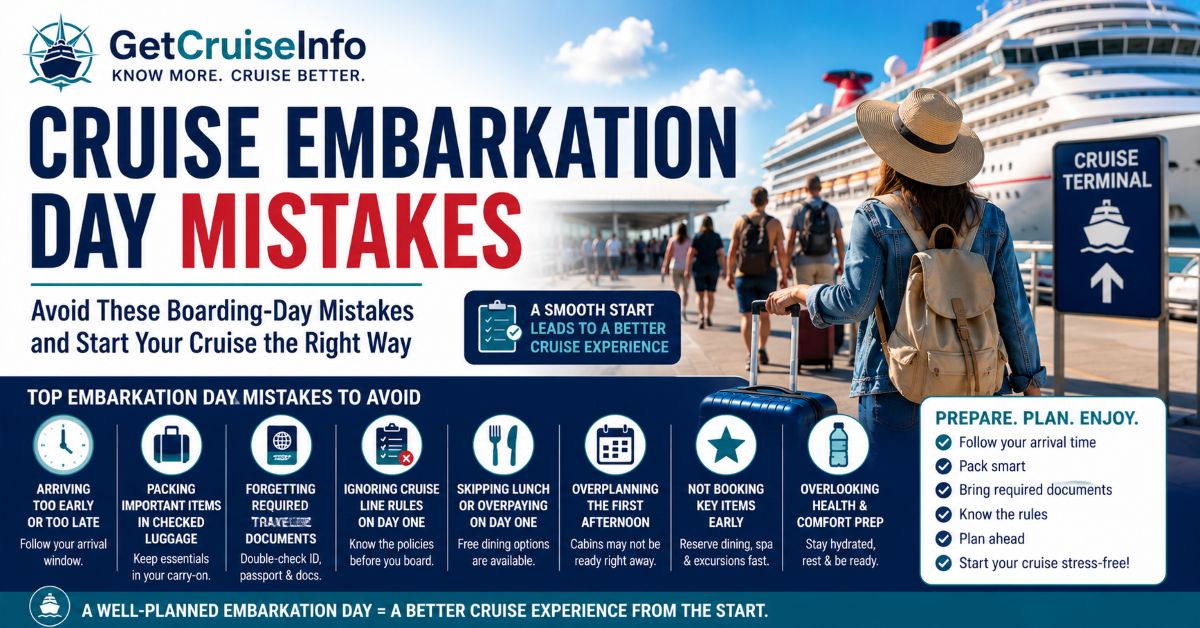
Common Embarkation Day Mistakes to Avoid
- Flying in the morning of the cruise: One disruption can eliminate your entire travel buffer.
- Arriving at the terminal extremely early: You may simply create a longer and less comfortable wait.
- Confusing departure time with final boarding time: You must be onboard well before the ship sails.
- Packing documents or medication in checked luggage: You may not have access to the bag when needed.
- Ignoring app notifications: The cruise line may send important boarding, safety, or schedule information through its app.
- Trying to do everything at once: Take care of time-sensitive tasks, then give yourself permission to settle in.
- Starting the day exhausted or dehydrated: Travel, heat, walking, and crowds can make the first day more tiring than expected.
If you are concerned about motion, review our Cruise Motion Sickness Guide before departure rather than waiting until the ship is underway.
Frequently Asked Questions
Should I fly in the day before my cruise?
Yes, whenever reasonably possible. Arriving the day before gives you time to recover from many flight delays, cancellations, weather problems, and missed connections. A hotel night is an added expense, but it can help protect the much larger cost of the cruise.
What time should I arrive at the cruise terminal?
Arrive near the check-in window assigned by your cruise line. Allow additional time for traffic, parking, shuttles, and finding the correct terminal, but do not assume arriving several hours early will let you board early.
What is the difference between arrival time and departure time?
Your arrival window tells you when to report to the terminal. The ship’s departure time is when it is scheduled to sail. Final boarding is earlier than departure, so never use the sailing time as your deadline for reaching the port.
What should I keep in my cruise carry-on?
Keep passports and travel documents, medications, valuables, electronics, chargers, a swimsuit, and anything else you may need before your checked luggage reaches the cabin.
Can I go directly to my cabin after boarding?
Not always. Cabins may remain closed while attendants finish preparing them. Be ready to keep your carry-on with you until the cruise line announces that rooms are available.
What should I do first after boarding?
Complete the required safety process, connect to the ship’s app, and confirm any reservations that are especially important to you. After that, have lunch, explore at a comfortable pace, and wait for your cabin to open.
Some links may be affiliate links.
Request Cruise Options
Get Cruise Info & Personalized Cruise Matches.Tell us when you want to travel, where you'd like to go, and what matters most to you. We'll help identify cruise options that fit your dates, budget, travel style, and cabin preferences. Not sure which cruise line, ship, or itinerary you want? That's completely fine — many travelers start with nothing more than available vacation dates, a departure port, or a general idea of where they'd like to go.
Only know your available dates? That's enough to get started. You can also review our Find a Cruise by Date Guide to see how we narrow cruise options around a fixed vacation window.