
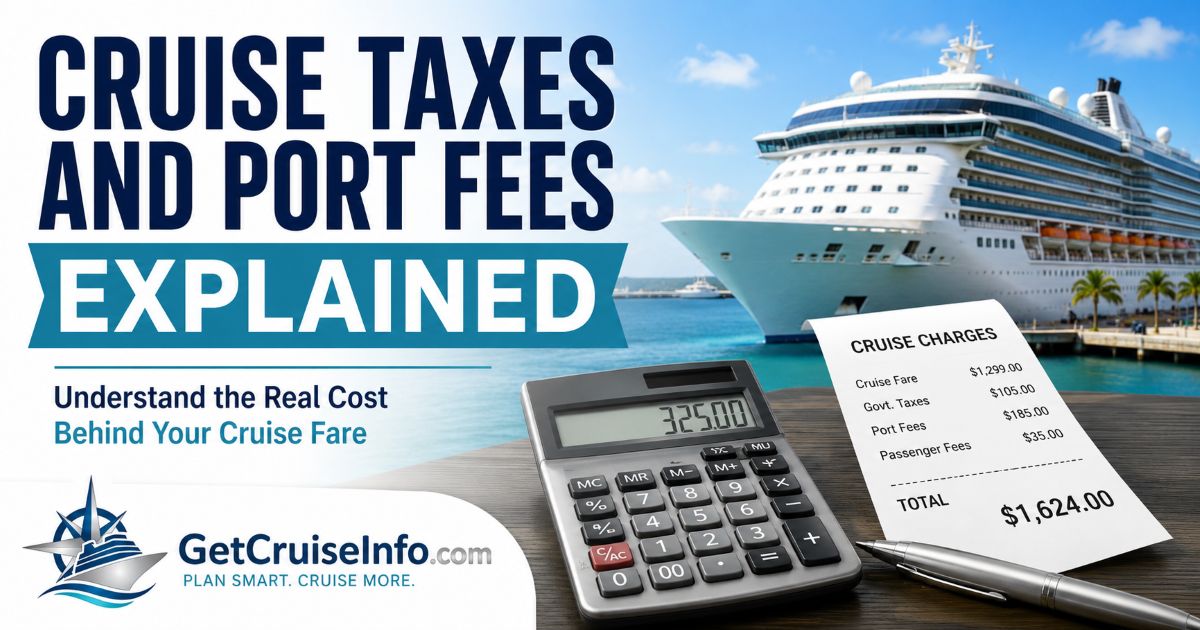
Cruise Taxes and Port Fees Explained
Understand what cruise taxes and port fees cover, how destination-specific tourism taxes can differ from cruise-line charges, and how these costs affect the real price of your cruise vacation.
Why Cruise Prices Often Look Lower Than the Final Cost
One of the most common surprises for first-time cruisers is discovering that the advertised cruise fare is not always the amount they will actually pay.
Many travelers find a cruise that appears to fit their budget, only to discover additional taxes, government fees, and port charges during the booking process.
This often leads travelers to believe cruise lines are hiding costs. In reality, many of these charges are collected separately because they are not retained by the cruise line itself.
Understanding cruise taxes and port fees is an important part of evaluating the true cost of a cruise before making a booking decision.
Taxes and port fees are only one piece of your cruise budget. Use our Cruise Total Cost Calculator to estimate the full cost of your vacation.
What Are Cruise Taxes and Port Fees?
Cruise taxes and port fees are charges associated with operating a cruise itinerary through various ports, countries, and government jurisdictions.
These charges may include passenger taxes, customs fees, immigration fees, security assessments, docking fees, terminal usage fees, and other destination-specific costs.
The exact amount depends on the itinerary, number of ports visited, countries involved, and local regulations.
A Caribbean cruise, Alaska cruise, Mediterranean cruise, and Panama Canal cruise may all have very different tax and fee structures.
This is one reason identical ships can sometimes show different total prices depending on the itinerary selected.
Who Receives These Fees?
A common misconception is that all taxes and port fees are additional profit for the cruise line.
In most cases, these charges are collected on behalf of governments, port authorities, terminal operators, security agencies, and other organizations involved in operating cruise infrastructure.
Ports require maintenance, security, customs processing, docking facilities, baggage handling systems, and passenger terminals.
The fees help support those operations and vary substantially from one destination to another.
This is why cruises visiting multiple countries often carry higher taxes and fees than shorter itineraries visiting fewer ports.
Why Are Taxes and Port Fees Listed Separately?
Cruise lines frequently separate taxes and port fees from the base cruise fare because these charges may change based on government regulations, itinerary adjustments, or destination-specific requirements.
Separating them also helps distinguish the actual cruise fare from mandatory third-party costs.
When comparing cruise offers, travelers should always evaluate the total cruise price rather than focusing solely on the advertised fare.
A lower advertised fare does not automatically mean a lower overall vacation cost.
Before comparing sailings, review our Cheap Cruises Guide and Best Cruise Deals Guide.
Are Port Fees the Same as Gratuities?
No. Cruise taxes and port fees are completely different from cruise gratuities.
Taxes, port fees, and gratuities all contribute to your final cruise budget. Estimate gratuities with our Cruise Gratuity Calculator.Taxes and port fees are generally mandatory charges associated with operating the itinerary. Gratuities are service-related charges connected to onboard crew compensation.
Travelers often confuse the two because both appear as additional charges beyond the advertised cruise fare.
However, they serve entirely different purposes.
For a detailed explanation of onboard service charges, see our Cruise Gratuities Explained Guide.
Why Some Cruises Have Higher Port Fees Than Others
Not all cruise destinations cost the same to operate.
Certain ports require higher passenger fees, terminal charges, environmental assessments, or local taxes.
Cruises visiting numerous ports may accumulate more fees than itineraries with fewer stops.
This can be particularly noticeable on destinations such as:
Longer and more complex itineraries generally encounter more jurisdictions and more associated fees.
Destination Tourism Taxes: Mexico VISITAX and Other Local Charges
Not every mandatory government charge connected to a cruise is necessarily collected as part of the cruise fare. Some destinations impose separate tourism taxes on foreign visitors, and the rules can depend on where you visit, how you arrive, and how long you stay.
Mexico provides a useful example. Cruise travelers may encounter different state-level charges in Quintana Roo and Baja California Sur, and these should not be confused with the normal taxes and port expenses shown on a cruise reservation.
Quintana Roo VISITAX and Cruise Passengers
Quintana Roo, home to Cozumel, Cancún, Playa del Carmen, Tulum, and much of the Riviera Maya, imposes VISITAX on foreign tourists. The State of Quintana Roo's official VISITAX guidance specifically states that the charge applies to foreign tourists visiting Cozumel regardless of their method of departure.
This is particularly important for cruise passengers because Cozumel is one of the busiest cruise destinations in the Caribbean. A traveler should not assume that a destination-level tourism tax is included simply because the cruise reservation already shows taxes, fees, and port expenses.
Quintana Roo also has a separate statutory charge for cruise passengers whose ships enter a port in the state. That cruise-passenger charge is distinct from VISITAX, reinforcing why travelers should distinguish between charges collected through a cruise booking and tourism taxes that may have separate payment requirements.
Travelers can verify current VISITAX requirements and payment information through the official Quintana Roo government portal at visitax.gob.mx. Because rates and collection procedures can change, verify the current amount before travel rather than relying on an older quoted price.
Baja California Sur: Embrace It Tourism Tax
Baja California Sur, which includes Los Cabos, La Paz, and Loreto, administers a separate tourism charge known as Embrace It. For 2026, the official state payment portal lists the tax at 488 Mexican pesos per eligible traveler.
There is an important difference for cruise travelers: Baja California Sur government guidance describes the charge as applying to foreign visitors who stay in the state for more than 24 hours or at least one night. That means a typical same-day cruise port call should not automatically be treated the same as a traveler staying overnight in Cabo or elsewhere in the state.
Cruise passengers extending their trip with an overnight stay in Baja California Sur should check the current eligibility rules. The official state portal is embrace.bcs.gob.mx.
Do Not Assume Every Mexico Tax Works the Same Way
Mexico tourism charges are not one nationwide cruise tax. Different states can establish different requirements, exemptions, payment methods, and eligibility rules. A rule that applies to a cruise passenger visiting Cozumel should not automatically be applied to a passenger making a short port call in Cabo San Lucas.
Before traveling, check the requirements for the specific destination and use official government sources whenever possible. This is especially important when an itinerary includes an overnight stay, a pre- or post-cruise hotel, or independent travel within Mexico.
How Taxes and Fees Affect Cruise Budgeting
Taxes and port fees are only one part of the overall cruise budget.
Travelers should also account for gratuities, shore excursions, drink packages, specialty dining, Wi-Fi, travel insurance, parking, flights, and pre-cruise hotel stays when applicable.
Looking only at the cruise fare often results in an unrealistic vacation budget.
Successful cruise planning focuses on the complete trip cost rather than a single advertised number.
Our Cruise Planning Guide and Cruise Essentials Guide can help travelers estimate total cruise expenses more accurately.
When Are Taxes and Fees Paid?
Taxes and port fees are generally included as part of the booking cost and become part of the overall reservation balance.
Depending on the cruise line and booking timeline, they may be reflected in deposit calculations, final payment amounts, or both.
This is one reason travelers should understand how cruise payment schedules work before booking.
Review our Cruise Deposit vs Final Payment Guide to understand when cruise balances become due.
How to Compare Cruise Prices Correctly
When comparing cruises, always compare total trip cost rather than advertised fare alone.
The lowest advertised fare may not produce the lowest final vacation cost once taxes, fees, gratuities, transportation, and onboard spending are considered.
Comparing complete costs helps travelers avoid surprises and make better cruise decisions.
It also helps identify situations where a slightly higher cruise fare may actually provide better overall value.
Our Cruise Line Comparison Guide can help evaluate overall value beyond pricing alone.
Understand the Full Cost Before You Book
Cruise taxes and port fees are a normal part of cruise pricing.
The key is understanding that advertised fares rarely represent the final vacation cost.
When evaluating a cruise, look at the complete financial picture including taxes, fees, gratuities, transportation, and onboard spending.
Better cruise decisions happen when travelers compare total costs rather than headline prices.
Frequently Asked Questions
What are cruise taxes and port fees?
Cruise taxes and port fees are charges associated with ports, governments, security requirements, terminal operations, and passenger processing.
Do cruise lines keep port fees?
Generally, port fees are collected to support ports, governments, and related operational entities rather than serving as direct cruise line revenue.
Why do taxes and fees vary between cruises?
Different destinations, countries, ports, and itinerary structures create different tax and fee requirements.
Are port fees the same as gratuities?
No. Port fees support destinations and infrastructure, while gratuities relate to onboard service compensation.
Do taxes and fees increase the final cruise price?
Yes. Taxes and fees are part of the total cruise cost and should always be considered when comparing sailings.
When do I pay cruise taxes and fees?
They are generally included in the reservation balance and paid as part of the overall booking cost.
Do cruise passengers have to pay Mexico VISITAX?
Quintana Roo's official VISITAX guidance states that the tax applies to foreign tourists visiting Cozumel regardless of their method of departure. Cruise passengers should verify current requirements through the official Quintana Roo VISITAX portal before travel.
Do cruise passengers have to pay the Baja California Sur Embrace It tax?
Baja California Sur government guidance describes Embrace It as applying to eligible foreign visitors who stay in the state for more than 24 hours or at least one night. A typical same-day cruise port call should therefore not automatically be treated as subject to the tax, but travelers with overnight stays should verify the current rules.
Are destination tourism taxes always included in the cruise fare?
No. Some destination-level tourism taxes can have separate payment requirements even when a cruise reservation already includes cruise taxes, fees, and port expenses. Always verify the rules for the destinations on your itinerary.
Request Cruise Options
Get Cruise Info & Personalized Cruise Matches.Tell us when you want to travel, where you'd like to go, and what matters most to you. We'll help identify cruise options that fit your dates, budget, travel style, and cabin preferences. Not sure which cruise line, ship, or itinerary you want? That's completely fine — many travelers start with nothing more than available vacation dates, a departure port, or a general idea of where they'd like to go.
Only know your available dates? That's enough to get started. You can also review our Find a Cruise by Date Guide to see how we narrow cruise options around a fixed vacation window.