
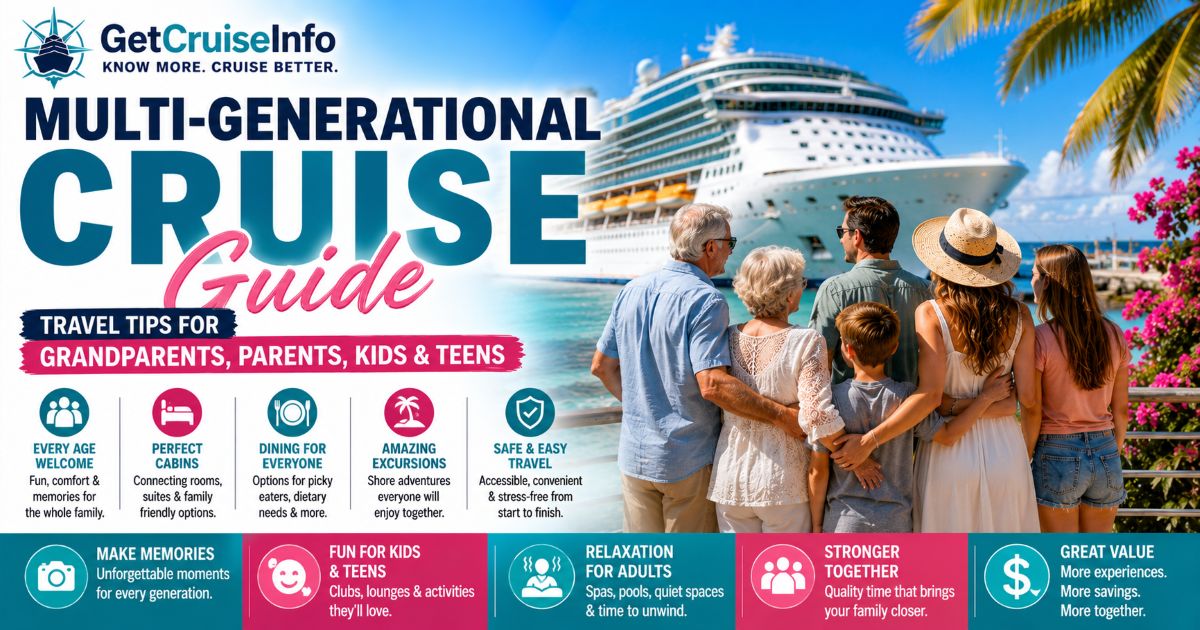
Multi-Generational Cruises Work Best When Every Age Group Gets a Different Vacation
The goal isn't maximum togetherness. It's creating the right moments together. Here's how to plan a cruise that works for grandparents, parents, teens, and younger children without forcing everyone onto the same schedule.
Why Cruises Work So Well for Multi-Generational Families
One of the hardest parts of planning a multi-generational vacation is that a grandparent, a parent, a teenager, and a six-year-old may have completely different ideas about what makes a great vacation.
That's exactly where cruising can work particularly well.
A cruise doesn't require everyone to enjoy the same activity at the same time. Grandparents can relax on deck, parents can spend a few hours at the pool, teenagers can find activities with other teens, younger children can participate in supervised kids programs, and everyone can meet again for dinner or an evening show.
My Approach as a Travel Advisor
The biggest mistake I see families make with multi-generational vacations is assuming that because everyone is finally together, everyone needs to do everything together.
That can turn a vacation into an obligation.
I recommend choosing a handful of experiences that genuinely matter to the entire family and making those the shared events. Then give people permission to separate.
The goal isn't maximum togetherness. It's creating the right moments together.
Cruises are particularly good at providing that balance because they combine:
- shared family experiences
- independent activities
- flexible dining
- entertainment for different age groups
- different activity and energy levels
- one consistent place to sleep each night
If some members of your family have never cruised before, start with our First-Time Cruiser Guide and Cruise Planning Guide.
Cruises Remove a Lot of the Logistics That Complicate Family Trips
Traditional multi-generational vacations can involve coordinating rental cars, restaurant reservations, hotel rooms, transportation, attraction tickets, and daily schedules for a large group.
A cruise consolidates much of that into one vacation.
- Your room stays in one place. You unpack once.
- Meals are readily available. Family members don't have to agree on a restaurant every time someone gets hungry.
- Entertainment is built in. Shows, pools, music, games, kids clubs, and other activities are typically steps away.
- Transportation between destinations is handled for you. The ship moves while the family sleeps, eats, or relaxes.
- People can separate and reconnect easily. Not everyone has to participate in every activity.
That last advantage may be the most important one.
Why Alaska Is One of My Favorite Multi-Generational Cruise Destinations
Alaska is particularly well suited to multi-generational cruising because much of the experience revolves around scenery, wildlife, and destinations that can appeal across age groups.
I recently cruised Alaska myself and visited Glacier Bay, Juneau, Ketchikan, and the White Pass area. Those experiences reinforced why I like Alaska for families traveling across generations.
A grandparent can appreciate Glacier Bay from the ship without committing to a physically demanding excursion. Parents and children can go whale watching in Juneau. Families can explore Ketchikan together, and the White Pass route provides an opportunity to experience dramatic Alaska and Yukon scenery without requiring everyone to hike for hours.
During my Juneau visit, we encountered whales at remarkably close range and also visited Mendenhall Glacier and a salmon bake. Experiences like those give families something memorable to share without requiring every generation to have identical interests or physical abilities.
Why the Ship Matters in Alaska
For a multi-generational Alaska trip, I would pay almost as much attention to the ship as the itinerary.
A ship with children's programming, comfortable observation areas, entertainment, multiple dining choices, and quieter spaces gives different generations somewhere to go when they aren't exploring Alaska together.
That makes it possible to spend part of the day as a family without expecting everyone to remain together from breakfast until bedtime.
Explore our Alaska Cruise Guide for more help planning an Alaska sailing.
Choosing a Cruise Line for a Multi-Generational Family
There isn't one cruise line that works for every multi-generational family. The better question is which line provides enough options for the particular generations traveling with you.
| Cruise Line | Why Families May Consider It | Best Fit |
|---|---|---|
| Royal Caribbean | Large activity selection, entertainment, kids programming, pools, and ships with many different things happening simultaneously. | Active families with children and teens who want lots of choices. |
| Disney Cruise Line | Strong children's programming, Disney entertainment, family-focused experiences, and dedicated adult spaces. | Families where Disney and children's experiences are a major part of the vacation. |
| Carnival Cruise Line | Casual atmosphere, family activities, entertainment, and often competitive pricing. | Families prioritizing casual fun and value. |
| MSC Cruises | Large modern ships, family-focused accommodations on some ships, international atmosphere, and broad activity choices. | Families interested in large-ship amenities and international cruising. |
| Princess Cruises | More relaxed atmosphere with strong destination focus and appeal to many mature travelers. | Families where grandparents and destination experiences are a major consideration. |
| Norwegian Cruise Line | Flexible dining and a relatively casual approach to scheduling. | Families that don't want every meal or evening structured around a rigid schedule. |
Compare additional options in our Cruise Lines Hub and Best Cruise Lines for Families guide.
Cabin Strategy Can Make or Break a Multi-Generational Cruise
Trying to squeeze too many people into one cabin may save money on paper while making the actual vacation considerably less enjoyable.
For many multi-generational groups, multiple cabins are the better strategy.
Consider:
- connecting cabins for parents and younger children
- nearby cabins for grandparents who want privacy but still want to be close
- balcony cabins for family members who value quiet personal space
- accessible cabins when mobility requirements make them necessary
- cabins near elevators when long walks may be difficult
Don't focus exclusively on cabin category. Location can matter just as much.
A beautiful cabin at the far end of a very large ship may be inconvenient for someone who has difficulty walking long distances.
Don't Make Every Meal a Family Production
Eating together can be one of the best parts of a family cruise, but requiring everyone to appear at the same restaurant at the same time three times a day creates unnecessary scheduling pressure.
A practical strategy is to designate one meal — often dinner — as the primary family gathering.
During the rest of the day, let people eat where and when it works for them.
This is especially useful when young children, teenagers, and older adults operate on very different schedules.
If your family does want to dine together every evening, discuss dining arrangements before sailing. Large groups may require advance planning to sit together.
Shore Excursions Don't Have to Include Everyone
One of the easiest ways to create friction on a multi-generational cruise is choosing excursions based on the most adventurous member of the family.
Before booking, consider:
- walking distance
- stairs
- heat and weather
- length of the excursion
- bathroom availability
- mobility requirements
- minimum and maximum ages
- how much time is spent riding in a bus or van
Sometimes the better solution is two excursions.
Part of the family might go ziplining while others take a scenic tour. Everyone can meet back aboard the ship afterward and compare experiences over dinner.
Think About Mobility Before You Choose the Ship and Itinerary
Accessibility shouldn't be an afterthought when grandparents or other family members have mobility limitations.
Large modern cruise ships can involve substantial walking. Ports may also involve long piers, tenders, uneven pavement, stairs, or transportation that isn't equally accessible to every traveler.
Before booking, consider both the ship and the ports.
Questions worth asking include:
- How far is the cabin from the elevators?
- Does someone require an accessible cabin?
- Does the itinerary use tender ports?
- Can everyone comfortably handle the planned excursions?
- Will anyone need wheelchair or scooter assistance?
These details are much easier to solve before the cruise than after boarding.
A Better Way to Structure a Multi-Generational Cruise Day
You don't need an hour-by-hour family itinerary.
A much simpler structure often works better:
Morning: Everyone follows their own schedule or smaller groups do different activities.
Afternoon: Choose one optional shared activity, pool session, excursion, trivia game, or other experience.
Dinner: Reconnect as a family.
Evening: Attend a show together or let different generations choose their own entertainment.
On a port day, the shared event might be the excursion instead. On a sea day, it might simply be dinner and a show.
The important thing is leaving enough unscheduled time for the vacation to actually feel like a vacation.
Grandparents Don't Automatically Need a "Quiet" Cruise
Age alone shouldn't determine the cruise line.
Some grandparents want a quiet balcony and destination-focused itinerary. Others want waterslides, nightlife, live music, casinos, or active excursions with their grandchildren.
The same applies to parents and teenagers.
Choose the ship based on what the actual people in your group enjoy rather than assumptions about what someone of a particular age is supposed to enjoy.
Practical Tips Before Booking a Large Family Cruise
- Agree on the budget early. Don't assume every household has the same vacation budget.
- Discuss cabin expectations. Decide who needs connecting rooms, balconies, accessible cabins, or extra privacy.
- Choose the important shared experiences. Don't schedule every hour.
- Discuss dining before sailing. Large parties can require advance arrangements.
- Review mobility needs honestly. Consider the ship, ports, and excursions.
- Give teenagers some independence. Establish clear rules and meeting times rather than requiring them to remain with the adults constantly.
- Build in downtime. Even children can become exhausted when every day is packed with activities.
- Consider travel insurance. Larger groups mean more people whose illness, injury, or other circumstances could potentially affect the trip.
- Arrive at the embarkation city early. I generally prefer arriving at least the day before a cruise rather than gambling the entire vacation on same-day transportation.
The Biggest Mistake: Trying to Create the Perfect Family Schedule
A multi-generational cruise doesn't succeed because everyone spent every minute together.
It succeeds when grandparents get meaningful time with their grandchildren, parents aren't exhausted from coordinating every detail, kids have experiences they'll remember, and everyone returns home feeling like they actually had a vacation.
Pick the moments that matter.
Maybe that's exploring Alaska together. Maybe it's one special dinner. Maybe it's watching a show, taking family photos, playing a game, or simply sitting together on deck as the ship leaves port.
Build the vacation around those moments and leave room for everyone to create some experiences of their own.
Frequently Asked Questions About Multi-Generational Cruises
Are cruises good for multi-generational families?
Yes. Cruises can work particularly well for multi-generational families because they provide shared experiences while allowing grandparents, parents, teenagers, and younger children to pursue different activities during the same vacation.
Which cruise line is best for grandparents and kids together?
There isn't one cruise line that's best for every family. Royal Caribbean and Disney Cruise Line offer extensive family activities and children's programming, while Princess may appeal to families looking for a more relaxed, destination-focused experience. Norwegian, Carnival, and MSC can also work well depending on the family's budget and vacation style.
Is Alaska good for a multi-generational cruise?
Yes. Alaska can be an excellent multi-generational cruise destination because scenery, wildlife, glaciers, and port experiences can appeal across age groups. Families can also choose excursions with different activity levels while using the ship as a consistent home base.
Should a large family book multiple cruise cabins?
Usually. Multiple cabins provide additional bathrooms, storage, privacy, and sleeping space. Connecting or nearby cabins can allow families to remain close without requiring several generations to share one room.
Should everyone take the same shore excursions?
Not necessarily. Different excursions can be a better choice when family members have different interests, ages, or mobility levels. Families can separate in port and reconnect aboard the ship afterward.
What is the biggest multi-generational cruise mistake?
Over-scheduling. Trying to make every family member participate in every meal, excursion, and activity can create unnecessary stress. Choose several meaningful shared experiences and allow everyone some independence.
Are cruises easier than traditional family vacations?
They can be. Cruises consolidate accommodations, transportation between ports, dining, and entertainment, which can reduce many of the logistical challenges involved in coordinating a large family vacation.
Some links may be affiliate links.
Request Cruise Options
Get Cruise Info & Personalized Cruise Matches.Tell us when you want to travel, where you'd like to go, and what matters most to you. We'll help identify cruise options that fit your dates, budget, travel style, and cabin preferences. Not sure which cruise line, ship, or itinerary you want? That's completely fine — many travelers start with nothing more than available vacation dates, a departure port, or a general idea of where they'd like to go.
Only know your available dates? That's enough to get started. You can also review our Find a Cruise by Date Guide to see how we narrow cruise options around a fixed vacation window.