Penguin Colonies
Gentoo, chinstrap, and Adélie penguins may be seen at different sites, with nesting activity changing throughout the austral summer.

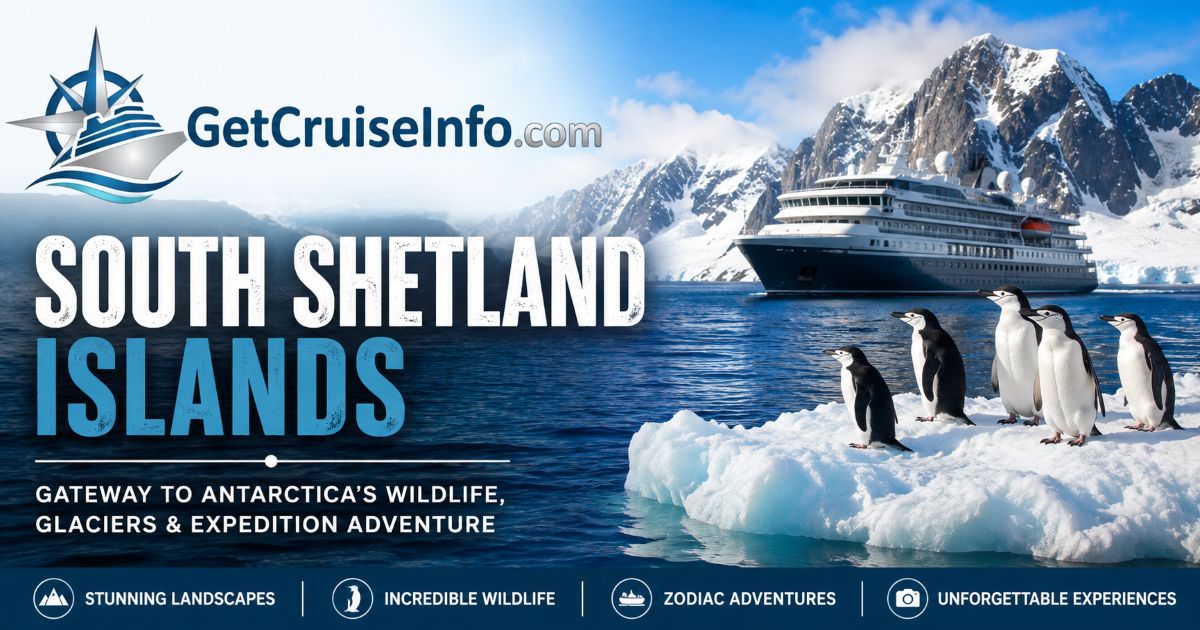
Explore the volcanic islands, penguin colonies, historic sites, research stations, and Zodiac landing opportunities that often introduce travelers to Antarctica.
The South Shetland Islands are an Antarctic archipelago located north of the Antarctic Peninsula across the Bransfield Strait. For many expedition travelers, these rugged islands provide the first landings, penguin encounters, and close-up views of the Antarctic environment after crossing the Drake Passage.
The island group combines glacier-covered mountains, active and dormant volcanic landscapes, protected bays, historic remains, international research stations, and important breeding areas for penguins, seals, and seabirds.
Most South Shetland visits are included within a broader Antarctica expedition cruise rather than sold as a stand-alone itinerary. Ships commonly explore the islands before or after visiting the Antarctic Peninsula, depending on weather, sea ice, wildlife activity, and the expedition leader’s daily plan.
This guide covers:
The South Shetlands offer an unusually concentrated introduction to Antarctica. In a relatively compact area, travelers may encounter several penguin species, hauled-out seals, volcanic terrain, glacier fronts, scientific stations, historic whaling remains, and dramatic channels suitable for Zodiac exploration.
Gentoo, chinstrap, and Adélie penguins may be seen at different sites, with nesting activity changing throughout the austral summer.
Deception Island is the flooded caldera of an active volcano and offers one of the most recognizable landscapes in Antarctic cruising.
Protected bays and beaches can provide landing opportunities when conditions elsewhere around the Antarctic Peninsula are less favorable.
Research stations, sealing history, whaling remains, and exploration sites add a human story to the wildlife and scenery.
No operator can guarantee a particular landing site. Wind, swell, snow, sea ice, wildlife protection rules, volcanic restrictions, and the presence of other ships can all change the day’s plan. A strong expedition team uses the islands as a flexible range of possibilities rather than a fixed port schedule.
| Planning Question | Typical Answer |
|---|---|
| Location | North of the Antarctic Peninsula, separated from it by the Bransfield Strait |
| Typical season | Austral summer, generally from November through March |
| Most common embarkation point | Ushuaia, Argentina |
| Typical itinerary | South Shetland Islands combined with the Antarctic Peninsula |
| Common activities | Zodiac cruising, wet landings, penguin viewing, guided walks, photography, and historical interpretation |
| Common wildlife | Gentoo, chinstrap, and Adélie penguins; fur, Weddell, elephant, and leopard seals; whales and seabirds |
| Primary planning concern | Choose the expedition experience and number of operating days before focusing on cabin category |
Some fly-cruise programs use King George Island as an Antarctic air gateway, allowing travelers to bypass at least one Drake Passage crossing. These itineraries can reduce sea days but may be more vulnerable to flight delays caused by Antarctic weather.
The South Shetland chain includes numerous islands and smaller islets. Expedition itineraries rarely visit all of them, and each voyage develops differently. The following locations are among the best known.
The largest island in the group contains numerous international research stations and serves as the air gateway for many Antarctica fly-cruise programs. Expedition visits may focus on wildlife, station areas, or embarkation logistics.
Ships can sometimes enter the flooded volcanic caldera through Neptune’s Bellows. Possible sites include Whalers Bay, Telefon Bay, and other locations shaped by eruptions, glaciers, and human history.
A crescent-shaped island known for chinstrap penguins, Antarctic scenery, and views toward Livingston Island. Conditions and wildlife restrictions determine whether a landing is possible.
A large, mountainous island with glaciers, penguin colonies, research activity, and multiple potential expedition sites. Hannah Point is especially well known for wildlife viewing.
Famous for its connection to Ernest Shackleton’s Imperial Trans-Antarctic Expedition. Rough seas and exposed conditions often make landing difficult, so visits may be limited to scenic cruising.
A small island group in the English Strait that can provide penguin viewing, seals, and relatively sheltered Zodiac operations when local conditions cooperate.
A glaciated island with possible landing areas including Yankee Harbour, where wildlife and broad Antarctic landscapes can be major highlights.
One of the central islands in the chain, surrounded by channels that may be used for scenic navigation and expedition operations depending on ice and weather.
A heavily glaciated island west of Livingston Island. It is less frequently visited than the major landing sites, reinforcing why itinerary maps should be viewed as possibilities rather than promises.
Deception Island is one of the most distinctive destinations in Antarctica. The island is an active volcano whose flooded caldera forms a natural harbor. When sea and wind conditions permit, expedition ships enter through the narrow opening known as Neptune’s Bellows.
Whalers Bay contains remains associated with the island’s sealing, whaling, aviation, and scientific history. Volcanic eruptions during the twentieth century damaged or destroyed several facilities, and the dark beaches, steaming ground, ash layers, abandoned structures, and surrounding glaciers create an environment unlike most other Antarctic landing sites.
Some older accounts describe travelers digging into volcanically warmed sand or taking a “polar plunge” near shore. Current activities depend entirely on operator procedures, environmental rules, volcanic risk management, and the expedition leader’s authorization. Travelers should never assume swimming or bathing will be offered.
Wildlife varies by island, month, sea-ice conditions, food availability, and breeding stage. The islands are especially important for penguins and seals, while whales may be encountered in surrounding waters.
Recognizable by the narrow black line beneath the head, chinstraps are strongly associated with several South Shetland colonies, including sites around Deception and Half Moon islands.
Gentoo colonies are found at several landing areas. Their orange bills, white head markings, nesting behavior, and busy pathways make them a favorite among photographers.
Adélies may be encountered at selected locations and are closely associated with Antarctic marine ecosystems and seasonal sea-ice conditions.
Antarctic fur seals, Weddell seals, southern elephant seals, crabeater seals, and leopard seals may be seen on beaches, ice, or in the water.
Humpback, minke, and other whales may appear in nearby channels, particularly later in the season as feeding activity increases.
Skuas, giant petrels, Antarctic terns, sheathbills, storm petrels, and other seabirds add constant movement to colony and shoreline visits.
Visitors must follow expedition-team instructions around wildlife. Routes can be closed, landing areas shortened, or viewing distances expanded when animals are nesting, resting, molting, feeding, or showing signs of disturbance.
Expedition cruises visit during the austral summer, generally from November through March. No month is universally best. The right timing depends on whether the traveler prioritizes snow-covered scenery, nesting behavior, penguin chicks, longer daylight, whale activity, or late-season photography.
Expect extensive snow, fresh-looking landscapes, courtship and nesting behavior, and an early-season atmosphere. Ice may restrict access to some sites.
Long daylight, active colonies, egg hatching, and growing penguin chicks make this the core of the Antarctic travel season.
Larger chicks, increasing whale activity, changing light, exposed terrain, and stronger fur-seal presence at some locations can define the later season.
| Period | Potential Highlights | Important Tradeoffs |
|---|---|---|
| November | Snow, courtship, nesting, early-season ice | Some channels or landing sites may remain inaccessible |
| December | Long daylight, eggs, hatching, active colonies | Popular travel period with strong demand |
| January | Penguin chicks, busy colonies, broad landing possibilities | Conditions remain variable despite being mid-season |
| February | Larger chicks, whale activity, more exposed beaches | Snow may be less pristine around heavily used colony areas |
| March | Late-season light, whales, changing wildlife behavior | Shorter daylight and increasing autumn weather risk |
Most shore visits use inflatable Zodiac boats. Travelers commonly descend from the ship using a stepped gangway, ride to shore wearing waterproof outerwear and life jackets, and step into shallow water at a beach landing.
A typical landing may include a marked walking route, wildlife-viewing areas, historical interpretation, photography stops, and guides positioned throughout the site. Some visits are short and concentrated, while others involve longer walks over snow, rock, ash, mud, or uneven beach terrain.
Travelers with mobility limitations should discuss gangways, Zodiac transfers, landing assistance, and alternative onboard viewing with the operator before paying a deposit.
For a broader explanation of small-boat operations, read our Zodiac Cruise Guide.
The South Shetland Islands have a cold maritime Antarctic climate. Conditions can shift rapidly between sunshine, fog, snow, sleet, rain, and strong wind. Temperatures during the expedition season are often near freezing, but wind chill and wet clothing can make the environment feel considerably colder.
The islands may offer some shelter compared with the open Drake Passage, yet individual beaches and channels can still become unsafe quickly. A landing that appears calm from the ship can be canceled because of surf, katabatic wind, poor visibility, or a forecast change.
A successful Antarctic voyage is not measured by checking off every named site. The strongest itineraries are run by expedition teams capable of substituting a protected bay, Zodiac cruise, wildlife encounter, or alternate landing when the original plan becomes unsafe.
Several countries operate research stations in the South Shetland Islands, especially on King George Island. These facilities support work in meteorology, geology, marine science, biology, glaciology, and other fields.
A cruise itinerary may pass station areas or occasionally include a controlled visit, but research facilities are working environments rather than guaranteed tourist attractions. Access depends on station approval, health protocols, operational workload, weather, and the expedition schedule.
| Feature | South Shetland Islands | Antarctic Peninsula |
|---|---|---|
| Landscape | Volcanic islands, broad beaches, glaciers, research stations, protected bays | Mountain-lined channels, glaciers, icebergs, continental and island landing sites |
| Wildlife | Strong penguin and seal opportunities with important breeding colonies | Penguins, seals, whales, seabirds, and varied marine habitats |
| History | Sealing, whaling, aviation, volcanic eruptions, and international research | Exploration history, scientific bases, historic huts, and Antarctic Treaty activity |
| Typical role | Often the first or final Antarctic expedition area | Usually the central focus of a classic Antarctica itinerary |
| Access | Reached by ship or, on King George Island, by specialized charter flight | Reached mainly by expedition ship after the Drake crossing or fly-cruise transfer |
The best ship is not necessarily the newest or most luxurious. For the South Shetlands, the most important questions concern landing capacity, passenger count, expedition staffing, time allocated to off-ship operations, and how the operator manages weather-driven changes.
Layering and waterproof protection matter more than extreme-fashion cold-weather gear. The goal is to remain warm while standing still, dry during Zodiac spray and wet landings, and comfortable when walking.
Review our Cruise Motion Sickness Guide before departure.
Antarctic operators commonly require medical information and may require proof of emergency evacuation coverage. Travelers should confirm that their policy covers the full trip cost, expedition activities, pre-existing medical conditions when applicable, trip interruption, weather delays, and evacuation from a remote polar region.
Standard medical insurance may not pay for treatment outside the traveler’s home country or for specialized evacuation. Read our Cruise Travel Insurance Guide and verify the operator’s exact minimum requirements in writing.
The islands are a strong choice for travelers who want penguins, seals, seabirds, and the possibility of whale encounters within one expedition region.
Dark volcanic beaches, snow, glaciers, wildlife, historic structures, and rapidly changing light create broad photographic variety.
Research stations, polar exploration, sealing and whaling history, geology, and active volcanism add depth beyond scenery alone.
A classic South Shetlands and Antarctic Peninsula itinerary can be an excellent introduction to Zodiac travel and flexible expedition operations.
Travelers comfortable with wet landings, uneven terrain, cold weather, and schedule changes are more likely to enjoy the experience fully.
This is a poor fit for anyone who requires guaranteed ports, fixed daily schedules, extensive shopping, warm weather, or conventional cruise entertainment.
Antarctic tourism depends on strict visitor behavior. Expedition teams inspect and clean boots, outerwear, backpacks, tripod feet, and other equipment to reduce the risk of carrying seeds, soil, microorganisms, or animal material between landing sites.
Travelers interested in the broader environmental issues should also review our Sustainable and Eco-Friendly Cruise Guide.
South Shetland itineraries vary by ship size, landing schedule, included equipment, expedition staff, activities, and time spent around the Antarctic Peninsula. Compare the complete voyage rather than choosing solely by price or cabin.
Explore Antarctica ExpeditionsThey are located north of the Antarctic Peninsula, across the Bransfield Strait, and are commonly reached after crossing the Drake Passage from southern South America.
Yes. They are an Antarctic island group and are administered under the international Antarctic Treaty system, although several countries maintain territorial claims that are held in abeyance under the treaty framework.
Many classic Antarctic Peninsula itineraries plan to visit the island group, but no specific landing is guaranteed. Conditions determine whether ships explore the South Shetlands, the peninsula, or alternate sites.
Potential sightings include gentoo, chinstrap, and Adélie penguins; Antarctic fur seals, Weddell seals, elephant seals, leopard seals, whales, skuas, petrels, terns, and other seabirds.
Deception Island is an active volcanic island with a flooded caldera. Expedition ships may enter through Neptune’s Bellows and visit sites associated with volcanism, whaling, exploration, and scientific research.
Landings are uncommon because exposed shores, swell, wind, and difficult approaches often make operations unsafe. Some voyages instead offer scenic cruising when conditions permit.
Specialized charter flights serve King George Island for some fly-cruise programs. Weather delays are possible because Antarctic aviation depends on suitable visibility, wind, and runway conditions.
December and January offer long daylight and active penguin colonies, while November emphasizes snow and nesting behavior. February and March may provide larger chicks and stronger whale activity. The best period depends on the traveler’s priorities.
Summer temperatures are often near freezing, but wind, precipitation, Zodiac spray, and inactivity can make conditions feel much colder. Waterproof layers and protection for hands, face, and feet are essential.
The islands are usually included within an Antarctica itinerary lasting roughly 10 to 14 days, although fly-cruise programs and longer voyages to South Georgia or the Falkland Islands can vary considerably.
Penguins are widespread in the region during the expedition season, but no ethical operator should guarantee a particular species, colony, or landing site.
Yes, provided the traveler is comfortable with the Drake Passage, cold and wet conditions, Zodiac transfers, flexible schedules, and the physical demands of shore landings.
Continue planning with our Antarctica Expedition Cruise Guide or return to the Expedition Cruises Guide to compare polar destinations and expedition styles.
Tell us when you want to travel, where you'd like to go, and what matters most to you. We'll help identify cruise options that fit your dates, budget, travel style, and cabin preferences. Not sure which cruise line, ship, or itinerary you want? That's completely fine — many travelers start with nothing more than available vacation dates, a departure port, or a general idea of where they'd like to go.
Only know your available dates? That's enough to get started. You can also review our Find a Cruise by Date Guide to see how we narrow cruise options around a fixed vacation window.